Vitamin B12: Methylcobalamin vs Cyanocobalamin, Tablets, Injections & Nasal Spray
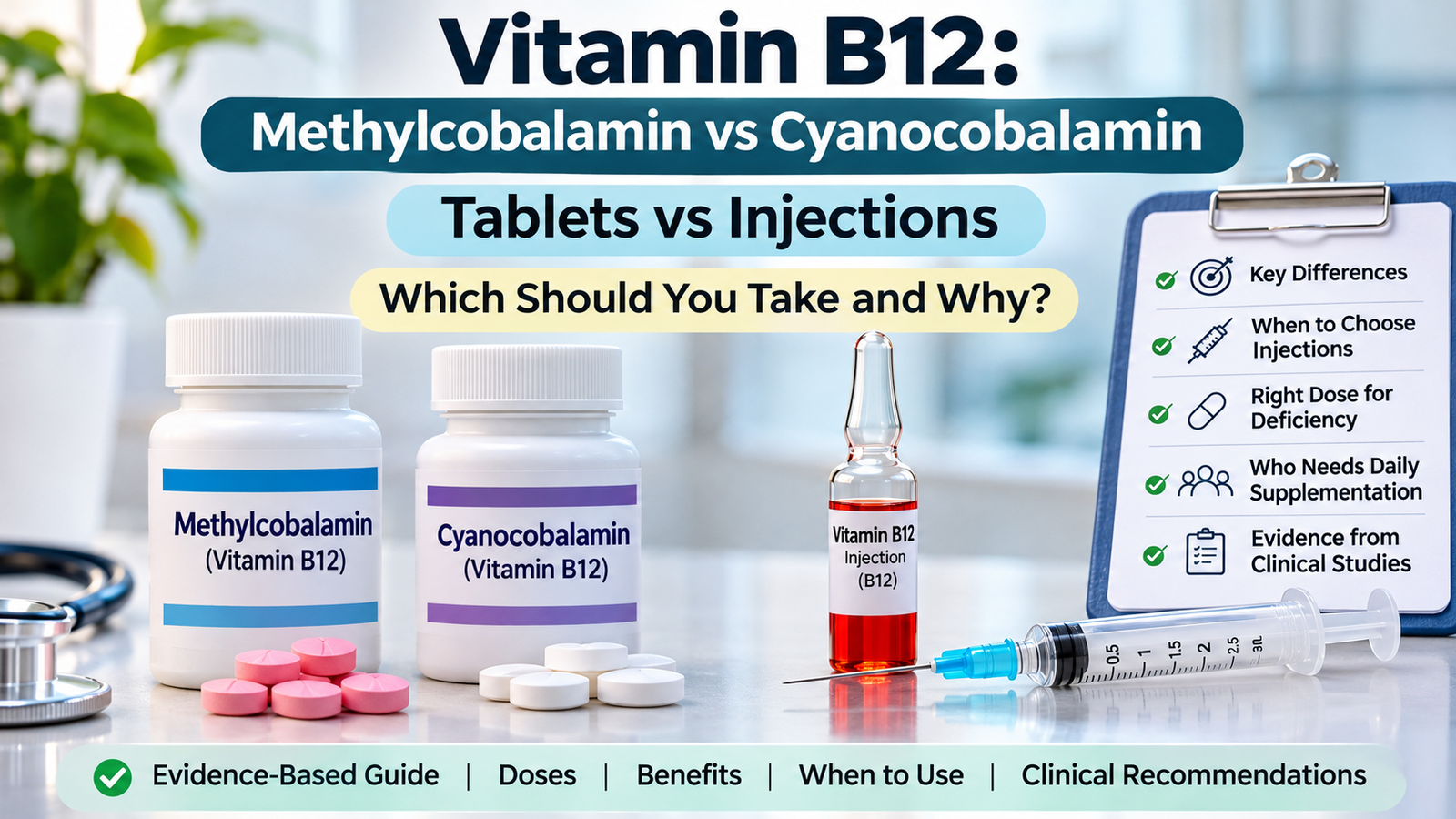
By Dr Omkar Singh, MBBS, MD (Medicine) | MedClarity | Medical review: 3 November 2026
A practical, evidence-based guide to choosing the right vitamin B12 formulation and route of replacement.
In this article
1. Why vitamin B12 matters
Vitamin B12 (cobalamin) is essential for DNA synthesis, red blood cell formation and normal neurological function. Deficiency can cause megaloblastic anaemia, glossitis, fatigue, paraesthesia, impaired vibration or position sense, gait disturbance and cognitive or mood symptoms. Neurological manifestations may occur even when haemoglobin and mean corpuscular volume (MCV) are normal.
Common causes include low dietary intake (particularly in people following a strict vegan diet without reliable supplementation), autoimmune gastritis, pernicious anaemia, gastric or ileal surgery, selected intestinal disorders and medicines such as long-term metformin. Proton-pump inhibitors and H2-receptor antagonists may also be associated with reduced B12 status in some people.
2. Methylcobalamin vs cyanocobalamin: which is better?
Methylcobalamin is one of the naturally occurring coenzyme forms of vitamin B12 and participates in the methionine synthase reaction. Cyanocobalamin is a stable, well-studied form used in many supplements and medicines. The body processes cyanocobalamin and converts it into the active coenzyme forms, including methylcobalamin and adenosylcobalamin.
Although methylcobalamin is often marketed as the “active” or “better absorbed” form, current clinical evidence does not establish that it is universally superior to cyanocobalamin for correcting ordinary vitamin B12 deficiency or preventing neurological complications. Cyanocobalamin has a long track record, good stability and generally low cost. Methylcobalamin is a reasonable alternative when an appropriate, quality-assured product is chosen.
| Feature | Methylcobalamin | Cyanocobalamin |
|---|---|---|
| Form | Active coenzyme form | Stable precursor form converted by the body |
| Clinical evidence | Used in supplements and some medicines; comparative superiority not established | Extensive clinical use and established evidence base |
| Stability and cost | May be less stable in some formulations; often costlier | Generally stable and economical |
| Practical choice | Acceptable option | Reliable first-line supplement option in many settings |
Clinical takeaway: The correct diagnosis, adequate dose, adherence and follow-up matter more than choosing a product solely because it says “methyl” or “active” on the label.
3. Vitamin B12 tablets vs injections
High-dose oral vitamin B12
High-dose oral B12 can correct deficiency in many patients, including some with impaired intrinsic-factor-dependent absorption. A small proportion of a large oral dose is absorbed by passive diffusion, independent of intrinsic factor. Clinical trials and systematic reviews support oral replacement as a practical option in selected patients, provided the dose is adequate and response is monitored.
Common therapeutic oral regimens use 1,000–2,000 micrograms (mcg) daily initially, depending on the cause, product and clinical context. This is a treatment dose, not the daily nutritional requirement. Follow the relevant guideline and individualise treatment rather than self-prescribing.
Intramuscular vitamin B12
Intramuscular (IM) replacement provides reliable delivery and is commonly selected when deficiency is severe, neurological features are present, rapid and dependable treatment is important, adherence to oral therapy is doubtful, or there is significant or irreversible malabsorption. People with autoimmune gastritis (pernicious anaemia), total gastrectomy or complete terminal ileal resection may require lifelong IM replacement under NICE guidance.
Not every person with a malabsorption risk automatically fails oral therapy. NICE advises considering IM treatment for malabsorption; if oral treatment is chosen in malabsorption, a dose of at least 1 mg daily is recommended. The choice should reflect the cause, severity, symptoms, patient preference and ability to monitor response.
| Clinical situation | Route commonly considered |
|---|---|
| Dietary deficiency, clinically stable, reliable adherence | Oral B12 is often suitable |
| Significant neurological signs or severe presentation | Prompt IM treatment is generally preferred |
| Autoimmune gastritis/pernicious anaemia, total gastrectomy or complete terminal ileal resection | Long-term/lifelong IM treatment as recommended by guideline |
| Malabsorption with oral treatment selected | At least 1 mg oral B12 daily with clinical follow-up |
| Uncertain response or poor adherence | Reassess cause, adherence and route; consider IM |
Do not delay treatment in a patient with convincing neurological features while waiting for every test result. If feasible, collect diagnostic blood samples before starting replacement.
4. Nasal vitamin B12 spray: a new option?
Intranasal B12 offers a needle-free route and avoids dependence on normal gastrointestinal absorption. It is an interesting option, but nasal products are formulation-specific and the evidence base is smaller than for oral and IM treatment. Nasal spray should not yet be considered a universal substitute for IM therapy in severe deficiency or neurological disease.
What does the research show?
A 2024 randomised study in older adults compared two intranasal B12 dosing regimens and contributed pharmacokinetic and dosing information. It does not establish that nasal treatment is interchangeable with standard IM replacement in every cause or severity of deficiency.
A 2026 randomised controlled trial from India compared intranasal, intramuscular and intravenous B12 in 153 adults with B12-deficiency anaemia, assessing haematological outcomes over 28 days. Haemoglobin increased in all groups. After adjustment, the study did not show a significant difference in haemoglobin improvement between routes; some secondary haematological responses differed. The short follow-up and focus on blood-count outcomes mean it cannot establish equivalent long-term neurological recovery, prevention of relapse or maintenance efficacy.
How should this change practice? The trial is promising and supports further evaluation of intranasal replacement. It is not sufficient on its own to replace established guideline-based IM treatment for severe or neurological deficiency. Route selection should continue to be based on the clinical presentation and the specific product's approved label.
Prescription nasal product example
In the United States, Nascobal is a prescription cyanocobalamin nasal spray delivering 500 mcg per 0.1 mL; its labelled regimen includes one spray in one nostril once weekly for specified indications. The US product label describes selected use, including maintenance in some patients after IM-induced remission of pernicious anaemia when nervous-system involvement is absent. This US label does not confirm approval, availability or an appropriate regimen in India. Check local regulatory status and product information before considering it.
Nasal congestion, allergic rhinitis or an upper respiratory infection may affect use. Follow the product-specific prescribing information; do not extrapolate a US brand's dose to another spray.
5. Daily requirement is not the same as treatment dose
The recommended dietary allowance for adults is 2.4 mcg/day in the United States. India's ICMR-NIN 2020 recommended dietary allowance for adults is 2.2 mcg/day. These values describe routine nutritional needs in generally healthy people; they are not doses for treating established deficiency.
Therapeutic regimens may use doses in the hundreds or thousands of micrograms because absorption is limited and the goal is to replenish body stores. The appropriate dose and duration depend on the cause, severity, route and response. People following a strict vegan diet should use a reliable B12 supplement or adequately fortified foods rather than relying on unfortified plant foods.
Long-term metformin use is associated with lower B12 levels in some patients. Consider testing when symptoms or risk factors are present and follow current diabetes guidance; supplementation should be based on clinical assessment rather than assuming every metformin user needs the same regimen.
6. How is vitamin B12 deficiency diagnosed?
Assessment usually begins with symptoms, dietary history, medication history, examination and a complete blood count (CBC), together with serum B12. If the result is indeterminate and clinical suspicion remains, methylmalonic acid (MMA) can help clarify deficiency. Homocysteine may be considered in selected situations but is less specific. Renal impairment can raise MMA, so interpret it in context.
If autoimmune gastritis is suspected, anti-intrinsic-factor antibodies may be appropriate. A negative result does not completely exclude the condition. Investigate the underlying cause rather than repeatedly prescribing supplements without a diagnosis.
Do not rule out B12 deficiency simply because the MCV is normal or anaemia is absent. Neurological symptoms can precede classic blood-count changes.
7. Who should consider testing?
8. Frequently asked questions
Is methylcobalamin better than cyanocobalamin?
Not universally. Methylcobalamin is an active coenzyme form, while cyanocobalamin is a stable form converted by the body. Robust evidence has not shown consistent clinical superiority of methylcobalamin for routine deficiency treatment.
Are B12 injections better than tablets?
Not for everyone. High-dose oral B12 works for many clinically stable patients. IM treatment is preferred in selected severe, neurological or irreversible malabsorption settings and when reliable delivery is essential.
Can nasal B12 replace injections?
Not routinely at present. Early studies are encouraging, but evidence for long-term neurological outcomes and maintenance in diverse causes of deficiency remains limited. Follow established guidelines and local product approvals.
Can B12 deficiency occur without anaemia?
Yes. Neurological manifestations may occur without anaemia or macrocytosis.
Should everyone taking metformin take B12?
No single supplement regimen is appropriate for everyone. Consider B12 testing when symptoms, anaemia, neuropathy or additional risk factors are present, and manage confirmed deficiency.
Can I take B-complex every day?
Check the ingredient list and dose. Long-term excessive vitamin B6 intake can itself cause peripheral neuropathy. Avoid stacking multiple supplements without reviewing total daily intake.
9. Practical conclusion
For most patients, the most important decision is not methylcobalamin versus cyanocobalamin; it is identifying why B12 is low and selecting a route and dose that reliably correct the deficiency. Oral B12 is convenient and effective for many patients. IM treatment remains important for severe or neurological presentations and certain irreversible causes. Nasal B12 is a promising, product-specific option, but current evidence does not justify treating it as a universal replacement for standard therapy.
Discuss persistent fatigue, anaemia, numbness, tingling or balance problems with a qualified clinician. Treatment should be individualised and response monitored.
Related reading on MedClarity
References
Medical disclaimer: This article is for education and does not replace individual medical assessment, diagnosis or treatment. Doses and routes should be selected by a qualified clinician according to the cause and severity of deficiency, local guidelines and approved product information.
Last reviewed: 3 November 2026.