Can We Regenerate Pancreatic Beta Cells in Diabetes? Latest Research
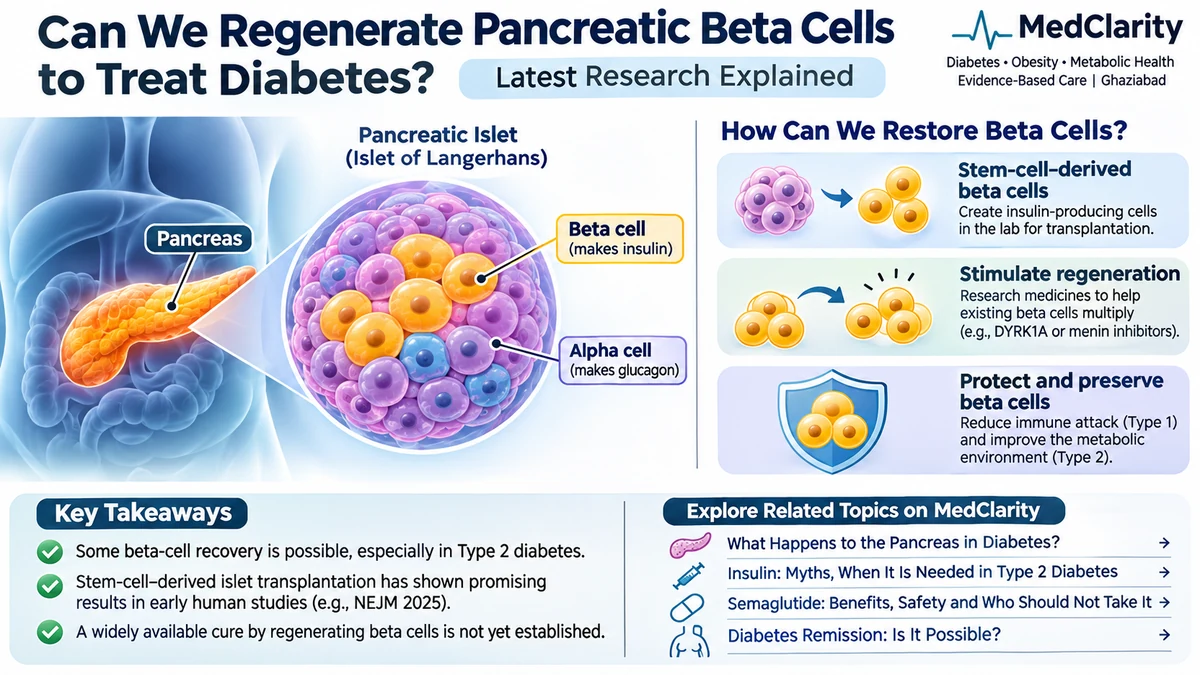
What does the latest research say?
Medically reviewed by Dr. Omkar Singh, MBBS, MD (Medicine) · Last reviewed: 16 November 2026
Could people with diabetes one day restore their own insulin-producing cells and stop insulin injections or other medicines? This is an active area of regenerative-medicine research. Scientists are studying beta-cell regeneration, protection and replacement using stem-cell-derived insulin-producing cells.
In brief: Some improvement in surviving beta-cell function is possible, and early human studies of beta-cell replacement are promising. However, a reliable, widely available treatment that regenerates the pancreas and cures diabetes is not yet established.

1. Why are pancreatic beta cells important?
Beta cells in the pancreatic islets of Langerhans produce insulin. In Type 1 diabetes, the immune system destroys beta cells, causing severe insulin deficiency. In Type 2 diabetes, insulin resistance increases the demand for insulin; beta-cell function may become inadequate over time. Read our guide to diabetes management in Ghaziabad.
2. Can the human pancreas naturally produce new beta cells?
Possible mechanisms include replication of existing beta cells, neogenesis from other pancreatic cell populations, and cellular reprogramming. Beta-cell replication is more active early in life and limited in adults. The contribution of neogenesis and reprogramming in adult humans remains uncertain. A 2025 review discusses these limitations: Pancreatic β-cell turnover in health and disease.
3. Can stem cells become insulin-producing cells?
Researchers can guide embryonic stem cells and induced pluripotent stem cells (iPSCs) into pancreatic progenitor cells and insulin-producing beta-like cells. This is generally beta-cell or islet replacement, not regeneration of the patient's own pancreas.
4. What have human clinical studies shown?
Zimislecel is an investigational allogeneic stem-cell-derived islet-cell therapy studied in Type 1 diabetes. Cells are infused into the portal vein and participants receive immunosuppressive treatment. In a 2025 Phase 1–2 report, all 14 participants with at least 12 months of follow-up had detectable C-peptide after treatment. Among 12 full-dose recipients, all were free from severe hypoglycaemic events and had HbA1c below 7% at day 365; 10 of 12 were insulin-independent at that time.
This was a small, early-stage study with limited follow-up. Immunosuppression was required, and long-term safety and durability need further study. It is not a routine cure. Read the original New England Journal of Medicine study (2025) and its ClinicalTrials.gov record, NCT04786262.
5. Can medicines regenerate beta cells?
DYRK1A and menin pathways are being studied for their role in beta-cell growth. These approaches remain experimental. GLP-1 receptor agonists such as semaglutide improve glucose-dependent insulin secretion and can support weight loss, but this does not prove that they regenerate lost beta cells in humans. Read our page on semaglutide: how it works, eligibility and safety.
6. Can beta-cell function improve in Type 2 diabetes?
In some people, reducing metabolic stress can improve the function of surviving beta cells. Weight loss, improved insulin sensitivity, better glucose control, physical activity and appropriate treatment may help. Some people achieve Type 2 diabetes remission after substantial, sustained weight loss. Remission does not prove new beta cells have formed, and diabetes can return. Explore our guide to evidence-based obesity and weight management.
7. Regeneration, functional recovery and remission are different
| Term | Meaning |
|---|---|
| Beta-cell regeneration | New insulin-producing beta cells are formed. |
| Beta-cell functional recovery | Surviving beta cells work better. |
| Diabetes remission | Blood glucose falls below the diabetes threshold without glucose-lowering medication for a defined period. |
A person can achieve remission without proving that their pancreas has regenerated.
8. Why is Type 1 diabetes especially challenging?
The autoimmune process that destroyed the original beta cells may also attack replacement cells. Successful therapy therefore needs both functional insulin-producing cells and a way to protect them. Researchers are investigating immunosuppression, encapsulation, gene-edited cells and immune-modifying treatments.
9. What is the future of diabetes treatment?
Research includes stem-cell-derived islets, immune-protected cells, beta-cell growth pathways, personalised cell therapy and improved transplantation methods. The goal is to produce cells that survive, respond to glucose and function safely for years. These advances remain distinct from routine diabetes care.
10. Should patients try commercial stem-cell therapy?
Be cautious about clinics promising a diabetes cure through unproven stem-cell injections. Check whether a treatment is part of a properly registered clinical trial, has appropriate regulatory and ethics approval, and has published human safety and efficacy data. Do not stop insulin or prescribed diabetes medicines because of claims about pancreatic regeneration.
Frequently asked questions
Can pancreatic beta cells grow back?
Adult human beta cells have limited regenerative capacity. Some functional improvement may occur, but reliable regeneration of lost beta-cell mass is not an established treatment.
Can stem cells cure Type 1 diabetes?
Early studies of stem-cell-derived islet replacement are encouraging, but this remains investigational and may require immunosuppression.
Can the pancreas regenerate in Type 2 diabetes?
Metabolic improvement can help surviving beta cells function better. This does not necessarily mean new beta cells have formed.
Does semaglutide regenerate beta cells?
Semaglutide improves glucose-dependent insulin secretion and supports weight management, but it is not a proven beta-cell regeneration treatment.
What is C-peptide?
C-peptide is released when the body makes its own insulin. A blood test can help assess endogenous insulin production in selected clinical situations.
Conclusion: Are we close to regenerating the diabetic pancreas?
The science is advancing, but we cannot yet routinely regenerate the pancreas and cure diabetes. Stem-cell-derived islet replacement is a major research direction for Type 1 diabetes. For Type 2 diabetes, improving insulin sensitivity, reducing metabolic stress and preserving surviving beta-cell function remain central strategies.
Medical consultation in Ghaziabad
For diabetes assessment and evidence-based management, consult Dr. Omkar Singh, MBBS, MD (Medicine), Consultant Physician.
Dr Omkar Singh Clinic, T1, MCC Signature Heights, Raj Nagar Extension, Ghaziabad, Uttar Pradesh 201017. Call +91 70427 72715.
This article is for medical education and does not replace individual medical advice. Do not discontinue insulin or prescribed diabetes medication without consulting your treating physician.
References and further reading
- Reichman TW, et al. Stem Cell–Derived, Fully Differentiated Islets for Type 1 Diabetes. New England Journal of Medicine. 2025;393:858–868. doi:10.1056/NEJMoa2506549.
- Alcibahy Y, et al. Pancreatic β-cell turnover in health and disease. Diabetes, Obesity and Metabolism. 2025. doi:10.1111/dom.70191.
- ClinicalTrials.gov: VX-880-101 / FORWARD study (NCT04786262).
- Carlsson PO, et al. Survival of Transplanted Allogeneic Beta Cells with No Immunosuppression. New England Journal of Medicine. 2025;393:887–894. doi:10.1056/NEJMoa2503822. This is an early single-patient report, not proof of an established treatment.